

For two years, every AI agent lived on its own island. The Model Context Protocol (MCP) is the bridge that connects them, and that shift matters more than its technical name suggests.
Until recently, adding an AI agent to a company was like hiring someone brilliant and locking them in an office with no phone. The agent could reason, draft, summarize. But to do anything useful with the CRM, the billing system, or the calendar, someone had to build a custom connection. One for every tool. One for every agent.
The result is familiar in many companies: automations that work in isolation, that nobody quite knows how they connect, and that break every time one piece of the system changes.
The Model Context Protocol (MCP) targets exactly that problem. And although it sounds like engineering jargon, the underlying idea is simple: give agents a common way to talk to tools and to other agents.
What MCP is, without the jargon
MCP is an open standard that defines how an AI model connects to external data, tools, and services. Anthropic introduced it in November 2024 and, within months, it went from one company's experiment to an industry reference point.
The clearest analogy is USB-C. Before, every device had its own cable and its own port. USB-C unified everything into a single connector: one port, many uses. MCP does the same for AI. Instead of a different connector for each combination of agent and tool, there is one common protocol everyone understands.
Underneath, the logic has three roles:
The host: the application a person works in.
The client: lives inside the host and manages connections.
The server: exposes what a tool can do, what data it can read, and under what rules.
For a decision-maker, the mechanics matter less than the consequence: agents stop being isolated.
The problem it solves: from N×M to N+M
Here is the point worth understanding, because it explains why MCP grew so fast.
Without a standard, connecting agents and tools is a problem that multiplies. With 5 agents and 10 internal systems, a company needs to build and maintain up to 50 separate integrations — each with its own authentication, data format, and errors.
That is the N×M problem: everything multiplies, and maintenance becomes a silent cost that grows with every new tool.
MCP turns that multiplication into a sum. Each tool connects once to the protocol, and each agent connects once too. That's how N×M becomes N+M. Fewer fragile integrations, less custom code, fewer things that break without warning.
It is not a cosmetic improvement. It is the difference between an operation that scales and one that tangles itself.
Why 2026 is the year this stopped being optional
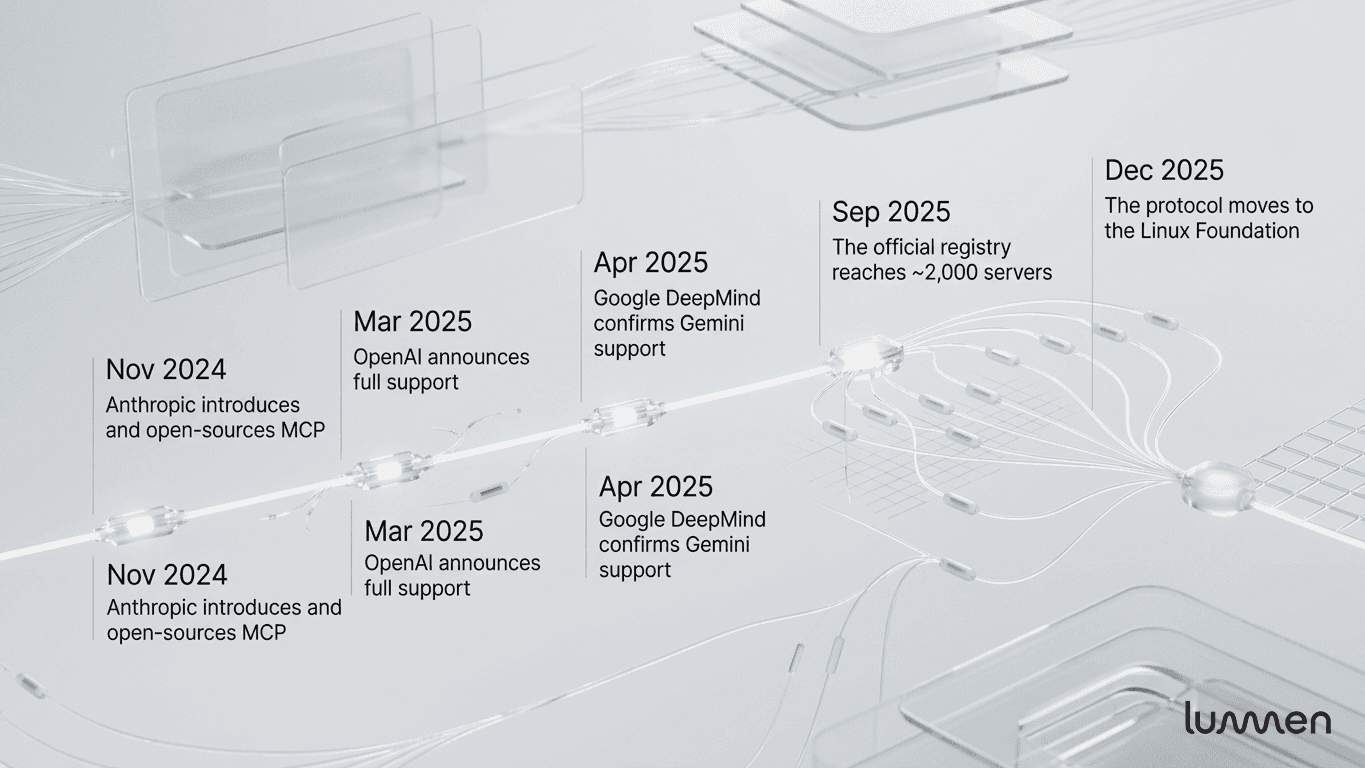
Adoption tells the story better than any prediction.
The community pulse confirms it: MCP's software development kits total roughly 97 million monthly downloads. Platforms like Slack, GitHub, Salesforce, Stripe, Notion, and Shopify already speak the language.
In parallel, Gartner reported a 1,445% surge in inquiries about multi-agent systems between early 2024 and mid-2025. The conversation moved from "one agent that helps" to "several agents working in coordination". And for several agents to coordinate, they first need a shared language.
What changes when agents truly connect
A concrete example. A company that takes orders across several channels usually has a fragmented process: one agent handles inquiries, another system manages stock, another issues the invoice. Each one works, but nobody coordinates them without a human in the middle.
With a common protocol, one agent can check stock, verify a company policy, update the system, and flag a person only when a real decision is needed. Not because the model is "smarter," but because it finally has orderly access to the tools it needs.
That is where Lumen usually draws a line: connecting agents does not mean loosening control. It means designing carefully where each agent can act alone and where it must escalate to a human. Connection expands what an agent can do; judgment defines what it should do.
What to look at before adopting it
MCP is not a tool you "install" that solves everything. It is a foundation to build on. Before adopting it, a few questions bring order to the decision:
What tools does your operation use today, and which already speak MCP? The answer defines how much value arrives on day one.
What data will be exposed to agents, and under what policies? A common protocol does not replace a clear data policy.
Where does the agent's autonomy end and human oversight begin? The familiar question, now with more surface area.
Can you audit what each agent did? If it can't be seen, it can't be controlled.
The deeper shift
For years, the promise of AI in companies hit a boring wall: systems didn't talk to each other. Every advance stayed locked on its island.
MCP is not a dazzling technology, it is something more useful than that: an agreement. A common language that lets agents stop working in solitude and start operating as part of a system.
And as with almost everything in automation, the value is not in the connection itself, but in the decision that orders it. Connecting is easy. Deciding what to connect, under what rules, and with what oversight remains human work.
That part, for now, no protocol solves.
Frequently asked questions
What is the Model Context Protocol (MCP)? It is an open standard, introduced by Anthropic in November 2024, that defines a common way for AI agents to connect to external tools, data, and services. It works like a "USB-C for AI": one protocol instead of a custom integration for every agent-tool pairing.
What is MCP used for in a company? It lets agents access the systems a company already uses (CRM, billing, messaging) in an orderly way, without building a separate connector for each. It lowers maintenance cost and lets automations scale without tangling.
Does MCP replace human oversight? No. MCP expands what an agent can do, but it does not define what it should do. Companies still need clear data policies and human checkpoints over sensitive decisions.
Who adopted MCP? Beyond Anthropic, OpenAI (March 2025) and Google DeepMind (April 2025) added support, alongside platforms like Slack, GitHub, Salesforce, Stripe, and Notion. In December 2025, the protocol moved to the Linux Foundation.

Let’s keep in touch.
Discover more about AI latest trends. Follow us on Linkedin and Instagram.


